Showing posts with label Washington Coast. Show all posts

Friday, March 6, 2015

Back Yard


Out in my garage, packed away in a box stored on some undetermined and probably cluttered shelf, are Sierra Club engagement calendars that I used in the late 1970's when I lived in my home state, Ohio. Though it has been something like 35 years since I made notations in those calendars so that I did not absent-mindedly forget a dentist appointment, or when I needed to get the oil changed in my car, or birthdays of family and friends, there are two things that, to this day, I remember very clearly about those calendars:

The photographs.
And the places where they were made.

There was an image of Comet Falls, the water dropping like a shot over a vertical rock face perhaps 300 feet high in Mt. Rainier National Park. And a photograph of the rock formations called sea stacks, looking like giant, geological shark fins, rising up near the beaches of the Pacific Ocean on the Washington Coast. I also remember pictures of the rainforest in Olympic National Park…and of the severe and scary-looking peaks of North Cascades…and of the basalt cliffs glowing red just before sunset near the Columbia River.

Those are places that are in my (extended) back yard now; and, thought I often miss family and friends in Ohio,  the Pacific Northwest has become our Home.

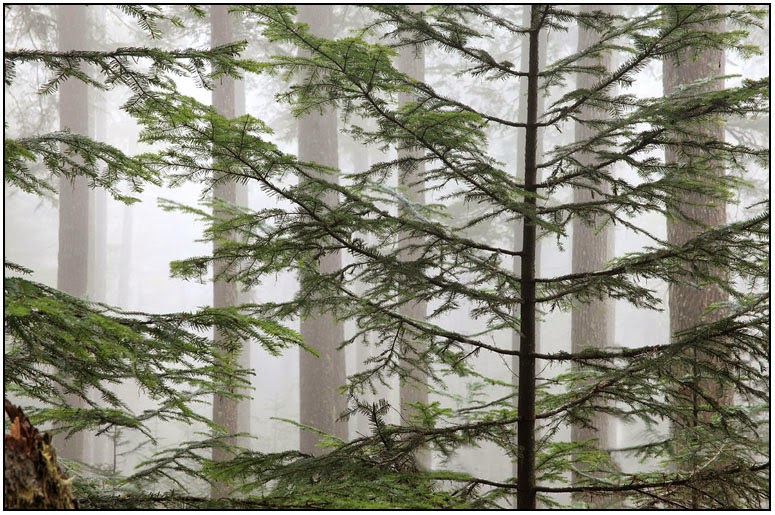
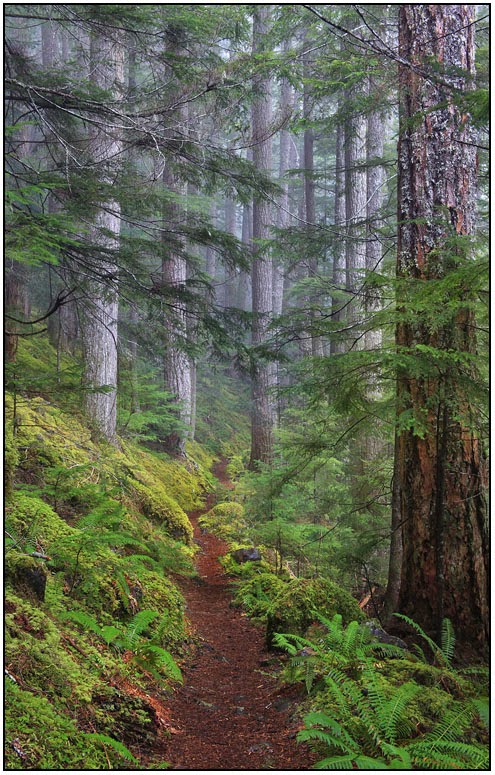
Several days ago a neighbor and I drove to the trailhead of the Buckhorn Wilderness, just 45 minutes from our homes, and we wandered with our cameras in the forests near the Olympic Mountains.

It was not a day where we hiked to get someplace. 

Rather, we were content to simply be.


Saturday, March 15, 2014

Big Cedar


If you look through any book on the history of the Pacific Northwest,  or walk into one of our regional natural history museums, you’d almost certainly see a photograph similar to the one above: Someone standing near a huge tree.

Sometimes the person photographed is a logger and he’s posing with a tree he just cut down;  and sometimes he/she is a hunter or a hiker on a trip in the backcountry wilderness. Whatever the circumstances of the picture, though --  and whether the picture was taken a hundred years ago or just yesterday -- the visual elements are always the same: Small human being, dwarfed by Big Damn Tree.  The picture has been done so many times over the years, it is a Pacific Northwest photographic icon.

Last month when Leah and I made a three hour drive out to the Washington coast to spend a night at an historic lodge in the Olympic National Park, we saw a kind of odd sign along the roadway: “Big Cedar Tree, one mile.”  We two are accustomed to big cedar trees -- we have several nice-sized cedars on our own property -- so we wanted to see, up close, a tree worthy of its own US National Park roadside parking area and nature trail.

Oh my! What a tree it was!  We walked around the tree, and we studied it.  We checked out its amazing, vein-like texture, and were even able to step inside.  I sweet-talked my photographically reluctant mate into letting me take her picture (I wonder how many camera-shy wives have stood in that same spot over the years, posing in that same way, for photo-enthusiast husbands.)  A Park Service sign near the tree said this:

    Big Cedar

Western redcedar has been the art and sinew of coastal Indian village life. The trunk is house plank and ocean-going canoe; branches are harpoon line; outer bark is diaper and bandage; inner bark is basket, clothing, and mattress.

Tree size expresses climate -- heavy annual rainfall and the nourishing damp of ocean fog. In a scramble for growing space, other tree species are using the cedar as a standing nurse log.

This week we learned that high winds and heavy rain from recent, late-winter storms have split the tree, and a part of the rainforest matriarch has fallen over. The news saddened us, but as I thought about it, I understood that this is the cycle of life in Nature.

Here’s a link to a news story about the tree:
 http://exotichikes.com/olympic-national-parks-kalaloch-cedar-destroyed-by-storm/


Wednesday, February 19, 2014

Not About Photography


Typically when I head off to Washington’s wild places, my trips are all about photography, or adventure, or both. I take my backpack loaded with the food, water, and clothing that I might need for a day (or several days) out. And of course I take a camera, a couple of zoom lenses, and a tripod.

More importantly,  I take a  mind that is open and ready to engage fully with the visual feeling of an environment.

Last Friday, however, as I was preparing for a trip to the Washington Coast, my traveling companion (my dear mate) made it known that she’d appreciate it if this outing differed,  stylistically and conceptually,  from my usual, jock, dirt-bag mode of adventure. It was Valentine’s Day and my funny valentine had planned a “getaway” for us. She’d booked a room at a nice lodge on the Pacific Ocean (no camping out in a tent with my smelly hiker friends this trip)  and made reservations in the lodge’s dining room for a special Valentine’s dinner (no freeze-dried backpacker food this day.)

“Can this trip not be about photography?” she asked. And, believe it or not,  I understood exactly what was being asked of me.

You see, I get it that, to someone not uber-engaged in photography,  there are other, non-image-making kinds of enjoyment one might find when strolling a beach on the ocean.  There are tidal patterns in the sand to marvel at, crashing waves to see and hear.

Thus, once we checked into the lodge, I left my camera bag and tripod in our room. My valentine and I did several walks on the beach.  I did have a compact camera in my pocket, and I shot a couple of snaps, kind of tourist-like.  But by and large, I was there, and present, and I tried to be good company.

I believe I can report that a good time was had by all.


Tuesday, September 21, 2010

Painting with Light


I remember the first day of the first photography class I took in college.
I can picture very clearly in my mind’s eye -- now 35 years removed from that classroom -- the professor sanding before my classmates and me, looking us over, sizing us up. I remember too the first thing the professor did. He asked us: “Does anyone here know the definition of Photography”?

I remember that question very well because...none of the students, myself included, had an answer. There was a sense in the air that we students had failed our First Big Test in a class that had barely begun.

“Photography means: “Painting with Light,” the professor said, casting a chilling scowl toward a hopeless lot of pathetic wretches.

That little 35-year-old scene popped into my head early last evening as my friend Jim and I hiked down a Pacific Ocean beach in the Olympic National Park. Jim is a fellow photographer I’ve known my entire professional career. There were other hikers out on that beach last night, but they were finishing their day’s outings and were headed back toward the trailhead and their cars, as Jim and I were just getting started.

Jim and I had a plan, you see. We wanted to be on the beach when the light was good. We wanted to paint with that good light.

We hiked for about 45 minutes. The sun was beginning to sink toward the western horizon when my friend and I arrived at some ocean sea stacks we’ve visited and photographed before. We set up our camera gear and then we waited. The light got better and better. We used our cameras to play with the visual elements of the stark rock formations, and we reveled in that beautiful sunset light.

Even after the sun slipped below the horizon, the light show went on. Warm reds and oranges were replaced by cool blues.

Some time later we repacked our gear and retraced the route we had walked earlier, down the now dusky beach. Eventually the full moon rose to light the way for us, back to the trailhead and our car.

It was a perfect evening to be out.