Showing posts with label Olympic National Park. Show all posts
Monday, June 13, 2016
Multi-chrome or monochrome?
I rarely spend a ton of time debating whether I like one of my photographs better in black in white, or in color. Images somehow seem to have a way of deciding that for me.
In these days of digital imagery, I shoot everything in color, knowing that I can always convert the picture to B&W later on the computer. Once I do that, I can toggle between the color image and the monochrome version on my computer display screen. If I'm still not quite sure which I like best, I happen to be married to someone whose visual taste I trust completely -- often more than I trust my own.
("Leah, can you come here and look at this?…")
Back in film days, color vs. black and white was a much tougher decision, at least for mountain trips where every ounce counts. Schlepping a backpack that held an extra camera body or film back loaded with color/B&W, or even extra film, on a hard hike of many miles and four or five thousand feet of elevation gain was a drag (literally.)
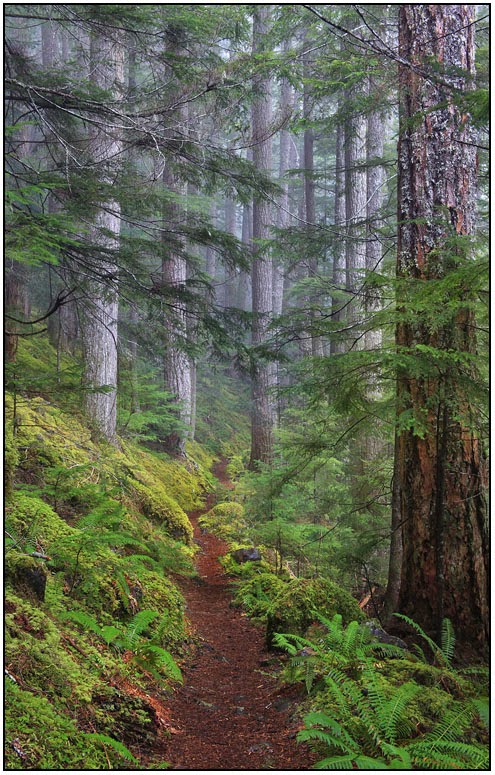
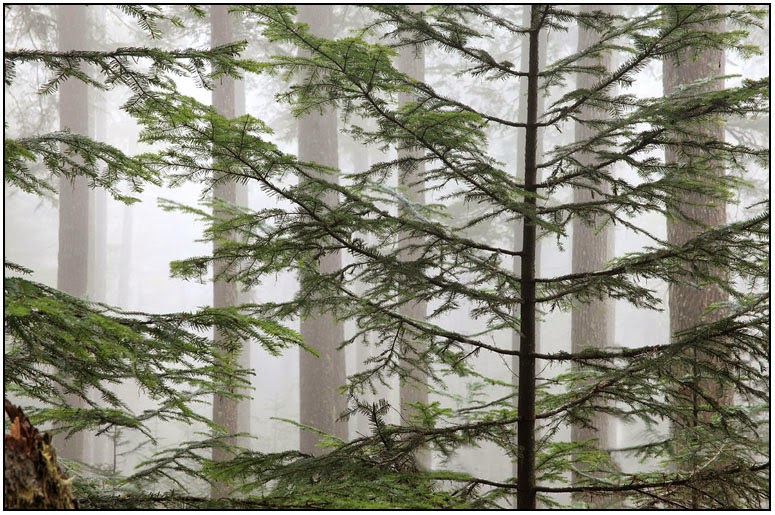
Today I'm posting images from recent hikes. The two above I like in color (though neither is particularly, um, colorful.) The bottom two I prefer in B&W.
I can be more than a little OC about most any consideration about my photographs... poorly-handled light or composition or technical mis-steps, all can and do make me crazy.
But color vs B&W? Nah, I'll save my angst for other worries.
Thursday, June 2, 2016
Up High
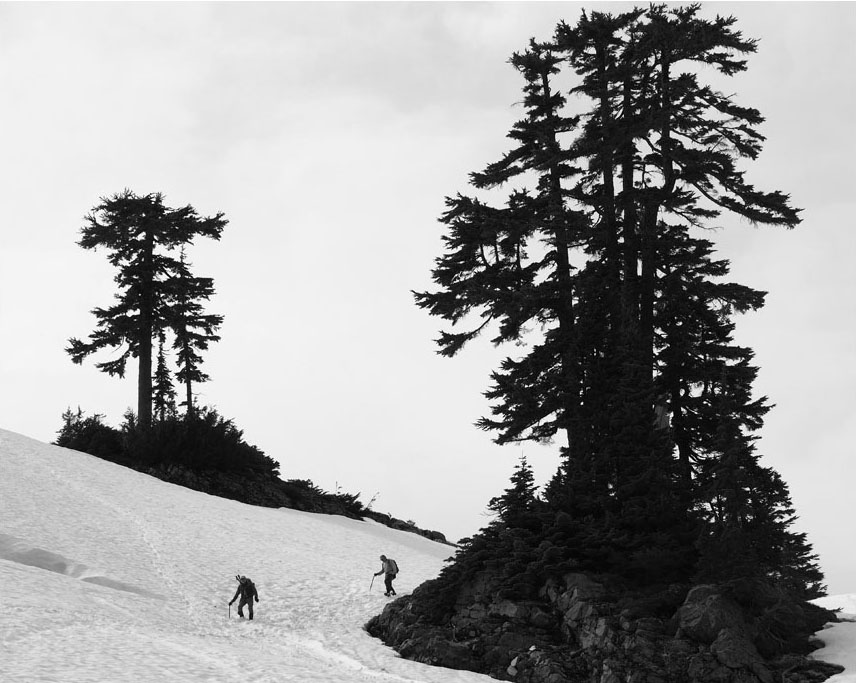
It seems like the mountain adventures I've been doing lately have presented me with circumstances that have resulted in images with a bit of a common thread: Relatively small human figures in an expansive, high country landscape.
The snow in my Washington state alpine playground is melting fast in this unusually warm spring…and thus, because we enjoy a pristine, white setting, my friends and I have been doing trips that take us higher and higher. Plans are afoot for an even more ambitious trek in mid-June into the North Cascades. If the weather cooperates and the trip comes off, it could be amazing. Stay tuned.
Until then, here are several images from the past several weeks.
Friday, April 22, 2016
Talking to Trees
An admission: I often talk to myself. Not silent and mindless monkey-mind chatter. I mean I talk out loud.
I'll be out alone, walking the half-mile trail that winds through the woods on one side of our property. I'll come around a bend in the trail and, through an opening in the trees, I'll see an eagle flying overhead, or, at my feet I'll notice a wildflower in bloom, and I'll say "WOW!"
If I'm feeling particularly verbal I might say "OH MY!"
Other times, when I'm out in the mountains on a hike with my friends and I see something amazing and comment about it, my friends probably think I'm sharing a thought with them. This is not necessarily so. I'd likely say the same thing if I was hiking alone…as if the big trees and ferns or the mountains might answer back.
Since today is Earth Day, I thought I'd post a number of recent photographs I have made when I saw something that prompted me to stop, and to respond, either verbally or photographically -- most likely, both.
Above are two pictures from the property where we live. Below are images from a hike two friends and I did in the nearby Olympic Mountains, starting out in lush, green forest and climbing up and up above the clouds into the alpine high country. It was a day of many WOW moments.
Monday, April 18, 2016
Prayers in the Wind
Two dear friends are experiencing ongoing (and I assume scary) health challenges, so on my last hike I put a small string of prayer flags on the summit of a beautiful peak in the Olympic Mountains.
Though I always practice a leave-no-trace ethos in wild places, the prayer flags I left seemed appropriate in that instance. If another climber comes along, my guess is that he/she also will have no problem with the prayer flags -- perhaps even smile and enjoy their presence. If not, the climber can remove them. By the time someone else visits that summit, the winds and weather will have spread the prayers anyway.
So, that's me in the photo above, a peak called "The Brothers" in the distance. Below is an image I shot in 2007 on our first (of two) trips to the Himalaya, in Nepal. Prayer flags are common there on a high mountain pass, or even on Buddhist shrines in cities.
Thursday, August 13, 2015
Nature's Ways
I have a wedding to photograph tomorrow evening and it will be held in a sweet little park on the east side of the Olympic Mountains not far from where I live. I'm sure that, as the bride and groom planned their event, they hoped for good weather because Hood Canal is nearby and there is a peaceful beach where wedding guests could gather to watch the sunset.
I've been keeping my eye on the weather forecasts; and though, for two months we have had no real precipitation to speak of -- there was a 30-second shower Tuesday that produced the rainbow above -- we might finally get some rain tomorrow. Nevertheless I suspect my wedding clients will happily hold their ceremony indoors in a quaint and cozy cabin on the park grounds, not complaining one bit if it rains on their big day. Our land is dry, dry, dry and we all know that "perfect" weather is not perfect.
All of the photographs I'm posting today were shot this week, offering a visual example I guess of the take-away/giveth ironies to be found in Nature:
A forest fire, caused by a lightening strike back in the Spring, has been smoldering in the Queets Valley Wilderness in Olympic National Park, perhaps two hundred miles away from my house. The fire flared up this summer and is taking away incredible old growth trees and putting smoke into the atmosphere.
At the same time, that smoke is making for some dramatic and "picturesque" evening skies.
Beauty is resulting from destruction.
Wednesday, August 5, 2015
Extremes
Anyone who has spent time in an alpine landscape can tell you that the mountains often are an environment of extremes: The sun is more intense up high than it is at sea level; winds in the mountains can knock you off your feet; and a chilly day in the lowlands can feel bone-chilling and frigid up high.
This past winter was a very light snow year in the Cascade Mountains, and this summer has been unusually hot and dry. High country hikes where I'd typically expect to find snow, even in July, take me this summer to a landscape that is bare and dry.
There has only been one day of rain in the last six weeks in the lowlands near Seattle, and lawns and gardens in populated areas are brown. Of more concern -- to me at least -- is that our mountains are tinder-dry, and fire danger in our forests is extreme. Two weeks ago I hiked in the Olympic Mountains, and the landscape (photo above) looked more like the arid American Southwest than the rainy and green Pacific Northwest.
I shot the two photographs below last Sunday when three friends and I hiked at Rainy Pass (not aptly-named this dry summer) in the North Cascades. Part of the day I could see and photograph the dramatic peaks that surrounded us. When the wind shifted from the southeast, however, haze and smoke filled the atmosphere, stark evidence of a wildfire that was burning near Lake Chelan about 50 miles away.
Monday, June 1, 2015
Smitten
I was in Ohio last week, visiting my mother, and, when I returned to the Pacific Northwest, it was as if the forests and big trees went out of their way to welcome me back home with stunning shows of beauty and photographic opportunity.
"Remember us?" the trees whispered, kind of like an old girlfriend temptress. "We missed you. Did you miss us?" The trees did not even pretend to be shy.
One day the dog and I were out for our early-morning stroll. The sun was rising and cast beams of yellow light through a thin veil of fog in the trees. The scene practically shouted "photograph me!"
Another day I took some visiting friends for a hike on a trail in the nearby Olympic National Forest. Rhododendrons were blooming, adding striking splashes of pink in an otherwise green-green-green scene.
My knees buckled and my old girlfriend smiled, knowing I was a goner for her. I'd buy her dinner, take her dancing, anything she wanted. The old flame was rekindled, and, even if I had wanted to, it was useless to resist.
Friday, March 6, 2015
Back Yard
Out in my garage, packed away in a box stored on some undetermined and probably cluttered shelf, are Sierra Club engagement calendars that I used in the late 1970's when I lived in my home state, Ohio. Though it has been something like 35 years since I made notations in those calendars so that I did not absent-mindedly forget a dentist appointment, or when I needed to get the oil changed in my car, or birthdays of family and friends, there are two things that, to this day, I remember very clearly about those calendars:
The photographs.
And the places where they were made.
There was an image of Comet Falls, the water dropping like a shot over a vertical rock face perhaps 300 feet high in Mt. Rainier National Park. And a photograph of the rock formations called sea stacks, looking like giant, geological shark fins, rising up near the beaches of the Pacific Ocean on the Washington Coast. I also remember pictures of the rainforest in Olympic National Park…and of the severe and scary-looking peaks of North Cascades…and of the basalt cliffs glowing red just before sunset near the Columbia River.
Those are places that are in my (extended) back yard now; and, thought I often miss family and friends in Ohio, the Pacific Northwest has become our Home.
Several days ago a neighbor and I drove to the trailhead of the Buckhorn Wilderness, just 45 minutes from our homes, and we wandered with our cameras in the forests near the Olympic Mountains.
It was not a day where we hiked to get someplace.
Rather, we were content to simply be.
Saturday, March 15, 2014
Big Cedar
If you look through any book on the history of the Pacific Northwest, or walk into one of our regional natural history museums, you’d almost certainly see a photograph similar to the one above: Someone standing near a huge tree.
Sometimes the person photographed is a logger and he’s posing with a tree he just cut down; and sometimes he/she is a hunter or a hiker on a trip in the backcountry wilderness. Whatever the circumstances of the picture, though -- and whether the picture was taken a hundred years ago or just yesterday -- the visual elements are always the same: Small human being, dwarfed by Big Damn Tree. The picture has been done so many times over the years, it is a Pacific Northwest photographic icon.
Last month when Leah and I made a three hour drive out to the Washington coast to spend a night at an historic lodge in the Olympic National Park, we saw a kind of odd sign along the roadway: “Big Cedar Tree, one mile.” We two are accustomed to big cedar trees -- we have several nice-sized cedars on our own property -- so we wanted to see, up close, a tree worthy of its own US National Park roadside parking area and nature trail.
Oh my! What a tree it was! We walked around the tree, and we studied it. We checked out its amazing, vein-like texture, and were even able to step inside. I sweet-talked my photographically reluctant mate into letting me take her picture (I wonder how many camera-shy wives have stood in that same spot over the years, posing in that same way, for photo-enthusiast husbands.) A Park Service sign near the tree said this:
Big Cedar
Western redcedar has been the art and sinew of coastal Indian village life. The trunk is house plank and ocean-going canoe; branches are harpoon line; outer bark is diaper and bandage; inner bark is basket, clothing, and mattress.
Tree size expresses climate -- heavy annual rainfall and the nourishing damp of ocean fog. In a scramble for growing space, other tree species are using the cedar as a standing nurse log.
This week we learned that high winds and heavy rain from recent, late-winter storms have split the tree, and a part of the rainforest matriarch has fallen over. The news saddened us, but as I thought about it, I understood that this is the cycle of life in Nature.
Here’s a link to a news story about the tree:
http://exotichikes.com/olympic-national-parks-kalaloch-cedar-destroyed-by-storm/
Thursday, December 8, 2011
In the Woods


It was 40-some years ago that my grandfather first introduced me to the exhilarating freedom of long, rambling tramps through the woods near his farm in Eastern Ohio. I was about 10-years-old and grandpa would let his two dogs -- a beagle, and a collie mix -- run loose and the dogs would kick up rabbits while my grandfather, a retired greenhouse owner, would teach me the names of wildflowers we’d see. Or we’d dig sassafras roots and later my grandpa would make tea that to me smelled like hot root beer.
Years later, when I was in college and already crazy about photography, I’d head to my grandparents’ farm on breaks from school and grandpa and I would continue to explore those fields and woods. I would take pictures then, hoping to preserve what I knew were precious times.
Today, when I pull out the photographs I did of my grandfather on our walks, I am humbled by the limitations of my photographic craft. I realize that I best remember those times-long-ago, not through my two-dimensional prints, but rather when I encounter the aroma of root beer or sassafras tea.
***
I thought I’d post pictures today from some recent walks in the forests where I live now in the Pacific Northwest.
The two images above were shot in the damp, ultra-green lowlands, where moss often covers the trees, and -- if one is attentive and fortunate -- chanterelle mushrooms can be harvested from the forest floor.
The images below are from a hike I did last weekend when I trekked up-up-up into the high country woods of the Olympic Mountains on a photographic hunt for ice formations on a wild, rushing creek.

Monday, April 4, 2011
Seeing Green

In the 31 years I have lived in Western Washington, my eyes have become accustomed to the color green, though I can tell you that this way of seeing was not always the case.
In 1977 we left Ohio and moved to the Pacific Northwest, settling and working first in Central Washington, in Yakima, just East of the Cascades. We lived in the rain shadow of the mountains then, a landscape of sagebrush and dry, generally brownish hills that had an Old West kind of feel. As a photographer, I would have told you back then that I knew colors, but the truth is that I really didn’t know green, at least not the way I know it now. It wasn’t until we’d lived for several months in Yakima and made our first drive west, over the Cascades, to spend a day in rainy Seattle, that I had my first Green Epiphany. I remember being slack-jawed, taken-aback, thrown off-balance by the ridiculous intensity of Western Washington's green.
We moved to the Seattle area in 1980, and today, as I sit in the second floor office I have in our home and type these words, I can look out the window to my left and the only thing my eyes take in is a rectangle of green, a huge cedar tree filling the frame...and the same is true of the view from the window to my right. I can hear that rain is falling outside -- which has been the case most days here since mid-September. I’m no botanist, but I’m pretty sure that, when it comes to trees and grass and the other plants that live outside my window:
4 months of rain
+ 3 more months of rain
= green
Anyway, we went hiking in the green yesterday, walking a path in the Olympic National Forest, about 30 minutes from our home. Our trail took us through a valley in the temperate lowlands and the day felt like spring, but all around and above us were mountains, high places still covered in winter’s snow, though now beginning its melt, so that the slopes dripped and seeped with runoff.
Drip, drip, drip. Every plant was soaking up the moisture, the creeks swelling. We came to a spot where a tree had fallen across a stream and the tree has become a "nurse log," a fertile host now for moss and ferns and baby trees. We could practically watch things grow.
1 drip
+ 2 drips
= life


Monday, February 21, 2011
Changing Light

This is an incredible time of year for photographic light, and, though I'm not completely sure why the light is so amazing, I do have a theory or two. Whether it was the sweeping, vast, outdoor landscape I saw on a ferry trip across Puget Sound, or a small, luminous scene at home in our kitchen, the light this week had a kind of a glow to it, a radiance.
It didn’t seem to matter much either, whether I made images in black and white, or in color, that special quality of the light was there. Something pretty cool was up, and I felt like I’d better pay attention.
I noticed that there was a spring-like breeze blowing off the Olympic Mountains, clouds were skittering across the sky, and trees were waving back and forth. The clouds and trees took turns, filtering the light, bouncing it around, reflecting it. Things got really freaky then, because the light seemed to be moving, pulsing, even, with a presence like a beating heart, thump-thump-thumping in a science fiction movie. It was a little weird, actually.
But I said I have a theory, and here is what I think is happening: The sun is still fairly low in the sky at this time of year, so there is an angularity to the light. The calendar says the season is still winter, but spring is knocking at the door. The weather forecasters are using words like “unsettled” to describe climactic conditions...one minute we get a little of this, the next we get a little of that, weather-wise, and one senses that there’s a whole-lotta-shakin-goin-on.
I plan to stay tuned.
Wednesday, January 5, 2011
No Nap

When we last met here in the Seeing Small clubhouse, I was telling you that several people I know had gone off to cool, adventurous-sounding places (Baja, for example) for the New Year’s weekend, but that Leah and I were feeling kind of lazy and decided we’d stay home, close to the wood stove. My Mom had been here visiting Christmas week and I’d been on the go-go-go entertaining her. The weather’s been clear and chilly out. A nap near the warm fire sounded good.
Then the phone rang. A photographer friend wondered whether I wanted to do a day trip out to the Washington Coast.
I went.
Our day was as varied as the landscape we passed through. I shot panoramas of frosty trees in the cool, shaded lowlands. Later we photographed mist on beautiful Lake Crescent. And we ended our day with a hike to Second Beach, where we watched the sun set into the Pacific. It was a fine day to be out and about.
Maybe I’ll nap next weekend.

Friday, December 3, 2010
Drive-by Beauty

There’s a waterfall I often photograph when I'm on my way out to the Washington coast. The waterfall isn’t terribly large and it’s right beside a busy road. Cars woosh past the waterfall and I suspect many drivers don’t even see it.
I've stopped at the spot dozens of times, however. There’s a wide shoulder beside the road a short walk away from the falls. I park my car, shoulder my camera bag and tripod, and go visit my little friend, the waterfall.
It’s really quite something, that drippy, verdant wall. Huge gobs of moss cling to the rocky hillside, and ferns grow like crazy there.
It’s kind of too bad that the road is so close to the falls, and that, if they see the falls at all, most people only look at it from a car window. It’s a place that can’t be appreciated at 50 miles an hour.
Tuesday, September 21, 2010
Painting with Light


I remember the first day of the first photography class I took in college.
I can picture very clearly in my mind’s eye -- now 35 years removed from that classroom -- the professor sanding before my classmates and me, looking us over, sizing us up. I remember too the first thing the professor did. He asked us: “Does anyone here know the definition of Photography”?
I remember that question very well because...none of the students, myself included, had an answer. There was a sense in the air that we students had failed our First Big Test in a class that had barely begun.
“Photography means: “Painting with Light,” the professor said, casting a chilling scowl toward a hopeless lot of pathetic wretches.
That little 35-year-old scene popped into my head early last evening as my friend Jim and I hiked down a Pacific Ocean beach in the Olympic National Park. Jim is a fellow photographer I’ve known my entire professional career. There were other hikers out on that beach last night, but they were finishing their day’s outings and were headed back toward the trailhead and their cars, as Jim and I were just getting started.
Jim and I had a plan, you see. We wanted to be on the beach when the light was good. We wanted to paint with that good light.
We hiked for about 45 minutes. The sun was beginning to sink toward the western horizon when my friend and I arrived at some ocean sea stacks we’ve visited and photographed before. We set up our camera gear and then we waited. The light got better and better. We used our cameras to play with the visual elements of the stark rock formations, and we reveled in that beautiful sunset light.
Even after the sun slipped below the horizon, the light show went on. Warm reds and oranges were replaced by cool blues.
Some time later we repacked our gear and retraced the route we had walked earlier, down the now dusky beach. Eventually the full moon rose to light the way for us, back to the trailhead and our car.
It was a perfect evening to be out.
Friday, July 30, 2010
Horizons


I live on a Pacific Northwest landscape where things tend to jut up above the horizon and point toward the sky: Trees, rock formations, mountains, for example. Even out along the Washington coast where one might expect the Pacific Ocean to be a fairly level scene -- water is flat, right? -- a look at the fantastic, otherworldly sea stacks will get your eyes to popping up and down like ping pong balls.
I’ve spent more than my fair share of evenings hanging out at various favorite spots near Puget Sound and the coast, wondering what the light will look like once the sun has set. Often I’m not just keeping my eye on the sea, but on the sky, and on the shapes that knife their way into the blueness (or orange- or red-ness.)
The pictures above are from past trips to Second Beach and Rialto Beach at the coast; the scene below was something I enjoyed two evenings ago as I waited for a ferry in Edmonds. I was a little bit taken-aback at the flatness of that evening, the calm water and the uninterrupted sky.
Initially I’d hoped to catch an earlier boat so I could be home in time for dinner. Had that come to pass, I would have missed seeing the wonderful light.
Tardiness has it’s merits, don’t you agree?
Subscribe to:
Posts (Atom)